
When operators calibrate a commercial roll-to-roll UV DTF (ultraviolet direct-to-film) printer, setting the UV LED curing lamp wattage is a precision balancing act rather than a “maximum-power-is-always-better” switch: under-curing leaves the bottom adhesive and white layer soft and prone to smearing under the laminating roller, whereas over-curing bakes the top clear varnish into a brittle glass-like shell that refuses to bond to the B-film carrier.
Mastering how UV LED irradiance interacts with carriage pass speed, ink film thickness, and inline lamination temperature allows commercial print shops to eliminate peeling failures across every roll of crystal labels.
How UV Photopolymerization Behaves Across Multi-Layer UV DTF Ink Stacks
In a single pass on a roll-to-roll UV DTF printer, photoinitiators inside the adhesive/primer, white titanium-dioxide underbase, CMYK colour layer, and clear top varnish absorb narrow-band ultraviolet light (typically 385–395 nm) emitted by the carriage-mounted UV LED lamps. That light triggers free-radical polymerisation, converting liquid monomers and oligomers into a solid cross-linked polymer network within a fraction of a second.
However, each layer in that vertical stack absorbs and blocks UV light differently:
- White titanium-dioxide pigment reflects and scatters UV rays: A dense white underbase requires sufficient deep-penetrating UV dosage to cure all the way down to the A-film release interface so the base does not slide under squeegee pressure.
- Dark black and navy CMYK inks absorb UV energy strongly: Heavy dark colour fills absorb photons near the surface, requiring balanced carriage speed so the bottom of the colour layer cures completely without curling the edges.
- Clear top varnish receives 100% direct surface irradiance: Because the transparent varnish sits unprotected at the very top of the ink stack, excessive UV lamp wattage rapidly over-cross-links the surface into a hard, low-tack crust before the web reaches the heated B-film nip roller.
UV LED Curing Calibration Matrix for Roll-to-Roll UV DTF Production
Technicians can dial in the exact UV LED power percentage for any A/B film and ink combination by checking four physical indicators on a short test strip.
| Curing State on Test Strip | Physical Symptom During Lamination & Peeling | Underlying Photochemical Cause | Immediate Lamp & Speed Adjustment |
|---|---|---|---|
| Under-cured base / white layer | Ink smears when rubbed firmly; greasy residue or cohesive split left on A-film backing | UV LED wattage too low or carriage speed too fast for the white ink density selected | Increase primary curing lamp power in 5%–10% steps or switch RIP from high-speed draft to standard production pass count |
| Over-cured brittle top varnish | Fine text and thin serifs stay stuck to A-film when peeling, or crack when wrapped on a curved mug | Excess UV dosage hardened the varnish surface completely before B-film lamination contact | Reduce varnish/trailing UV LED lamp percentage slightly so the top coat cures dry to the touch while retaining slight surface compliance |
| Edge curl (“tacoing”) on large solid badges | Thick solid crests curl upward at the perimeter on the A-film before hitting the laminator | Rapid exothermic shrinkage from blasting thick ink layers with 100% lamp power in minimal passes | Lower lamp intensity slightly and use a smoother higher-pass feather setting to distribute curing heat gradually |
| Balanced optimal cure window | Transfers lift 100% cleanly onto B-film, wrap smoothly around curved tumblers, and release cleanly at 180 degrees | Full depth cure through white base paired with tough, slightly flexible top varnish | Lock these lamp percentage and laminator roller temperature settings into the shop’s standard SOP |
Synchronising UV Curing Energy With Inline Heated Lamination
UV LED curing and inline B-film lamination are two halves of a single thermo-mechanical process. Even when UV lamp power is calibrated properly, running the inline laminating roller completely cold on a winter morning prevents the B-film adhesive from flowing around the micro-topography of cured UV varnish.
Conversely, when the top UV varnish retains a balanced degree of elasticity leaving the print zone and immediately enters a moderately warmed inline laminating nip roller under even left-to-right pinch pressure, the B-film adhesive wets out every 0.5 mm letter edge without trapping silver air halos. Operators should re-verify UV lamp glass cleanliness weekly—wiping away cured ink mist from the quartz window with dedicated UV cleaner when the lamp is cool—so a dirty lens does not trick the team into cranking wattage unnecessarily high.
Selecting Industrial 60 cm Roll-to-Roll UV DTF Printers With Precision Curing Control
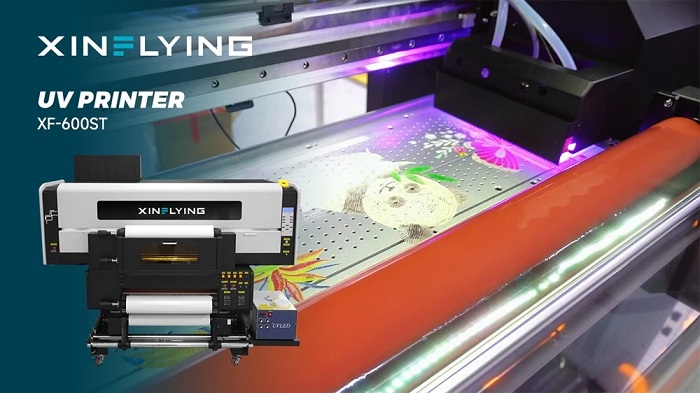
Consistent UV curing across wide 60 cm nested gang sheets requires stable LED cooling, uniform irradiance from edge to edge, and synchronized inline lamination tension. Print shop managers evaluating 60 cm industrial platforms such as the XINFLYING XF-600st and XF-600S—or comparing 42 cm and 45 cm configurations like the XF-420S, XF-420st, and XF-450S—can review the technical lineup across XINFLYING roll-to-roll UV DTF printer machines to match curing architecture and printhead channels to their production targets.
By pairing an industrial roll-to-roll platform like the XINFLYING XF-600st with disciplined UV LED wattage calibration and clean quartz lamp windows, commercial decorators achieve flexible, crack-free crystal transfers on both flat packaging and curved merchandise.