
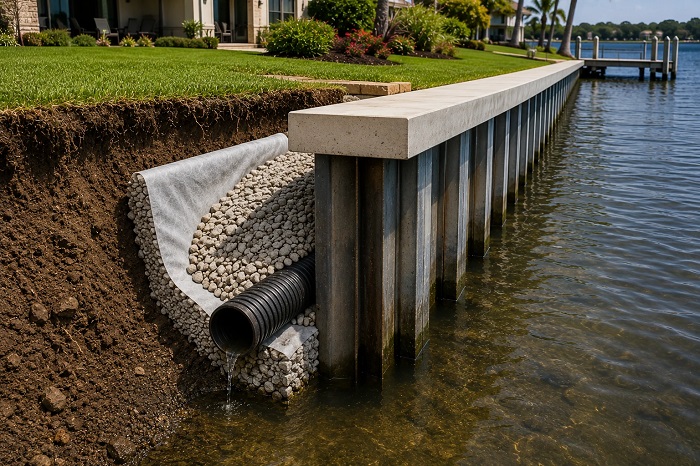
A seawall must handle pressure from water in front of it and soil behind it. Many property owners focus on the visible wall face, but the hidden parts of the system often determine how long the structure will perform. Drainage and foundation design are two of the most important details.
Before building or replacing a wall, owners should review professional seawall construction because strong shoreline protection depends on more than the surface material selected for the project.
When drainage is poor, water can collect behind the seawall. This creates hydrostatic pressure that pushes against the structure from the land side. Over time, that pressure can lead to movement, cracking, bowing, soil loss, and repeated repair needs.
The foundation is equally important. A seawall must transfer loads into stable ground. If the base is weak, too shallow, or poorly matched to the soil, the wall can settle, rotate, or shift. This is especially important on soft silty soils, open water shorelines, and properties exposed to storm conditions.
The hidden pressure behind a seawall
Water does not only attack a seawall from the front. Rainwater, irrigation, groundwater, and runoff can move through the property and collect behind the wall. If that water cannot drain, it creates pressure against the structure.
This pressure can be difficult to see at first. The wall may look normal from the water, while the land side becomes saturated. Eventually, the owner may notice soft soil, cracks, wall movement, or muddy water escaping through gaps.
Drainage allows water to leave the back of the wall without carrying soil with it. Depending on the design, this may involve drainage stone, filter fabric, weep holes, pipe systems, proper grading, and selected backfill materials.
- Hydrostatic pressure – trapped water behind the wall increases force against the structure and can cause movement.
- Soil migration – poor drainage can allow fine soil to wash through gaps, creating voids behind the seawall.
- Saturated backfill – wet soil is heavier and can place more stress on the wall than properly drained material.
- Surface runoff – water flowing toward the wall from the property should be redirected or controlled before it causes damage.
Why foundation design cannot be ignored
The foundation supports the wall and helps it resist movement. A seawall built on weak or unstable ground may fail even if the visible material is strong. The base must match the soil, water depth, wall height, and expected wave exposure.
Soft soils may require deeper support. Rocky conditions may require special excavation or installation methods. Taller walls may need stronger foundations because they hold back more soil. Open water conditions may require additional reinforcement because wave loads are more intense.
Foundation problems can appear as settling, tilting, cracking, or separation along the wall. In some cases, the problem starts below the waterline and is not obvious until visible damage appears above the surface.
How drainage and foundation work together
Drainage and foundation design should not be treated as separate details. Poor drainage increases the load on the wall. A weak foundation makes the wall less able to handle that load. When both are neglected, the risk of movement increases.
A properly drained wall reduces pressure, while a suitable foundation supports the structure against remaining forces. Together, they help the seawall perform as a complete system rather than a simple barrier placed at the water’s edge.
Material choice also connects to drainage and foundation. Wood, vinyl, concrete, stone, and gabion systems all have different structural behavior. For example, gabion systems can provide natural drainage through rock fill, while concrete walls may require more controlled drainage details behind the wall.
- Study the soil – clay, silt, sand, and rock affect foundation depth, drainage behavior, and installation methods.
- Measure wall height – taller walls hold back more soil and often require stronger support and better drainage.
- Review water exposure – open water, storm waves, and boat wake influence the load that the foundation must resist.
- Control land-side water – grading, drains, and backfill should prevent water from collecting behind the wall.
- Protect the ends – erosion around the ends of the seawall can undermine the system even when the main wall is strong.
Drainage details that improve seawall performance
Effective drainage begins with understanding where water comes from. Rainwater may flow from the yard toward the shoreline. Groundwater may move through the soil. Irrigation systems may add moisture near the wall. All of these sources should be considered.
Weep holes can help release water from behind some wall types, but they must be combined with proper filter layers so soil does not wash out. Drainage stone can create a path for water movement. Filter fabric can help separate soil from stone and reduce migration.
Backfill selection matters. Poor backfill can hold too much water or move too easily. Well-planned backfill supports drainage and helps reduce uneven pressure behind the structure. Compaction should also be handled carefully so the land behind the seawall remains stable.
Surface grading is another key detail. If the yard slopes directly toward the seawall without control, water may constantly collect behind the structure. Proper grading helps move water away or direct it into planned drainage paths.
Foundation details for different seawall systems
Different seawall types require different foundation approaches. Wood and vinyl systems may rely on piles, sheet piling, walers, and tie-backs. Concrete systems may require reinforced footings, deeper support, and careful forming. Stone and boulder systems need stable base preparation and proper placement.
Gabion seawalls need a base that can support the baskets without excessive settlement. The baskets must remain aligned and properly connected. If the base shifts, the entire system can deform even though the stone fill still appears present.
Foundation planning should also consider equipment access. Limited access can affect how piles are installed, how concrete is placed, or how large stones are moved. A practical design must be buildable on the actual property, not only correct on paper.
A seawall with strong visible materials but poor drainage or a weak foundation is not a complete solution. The best shoreline protection comes from designing the wall, base, drainage, backfill, and site transitions as one connected system.